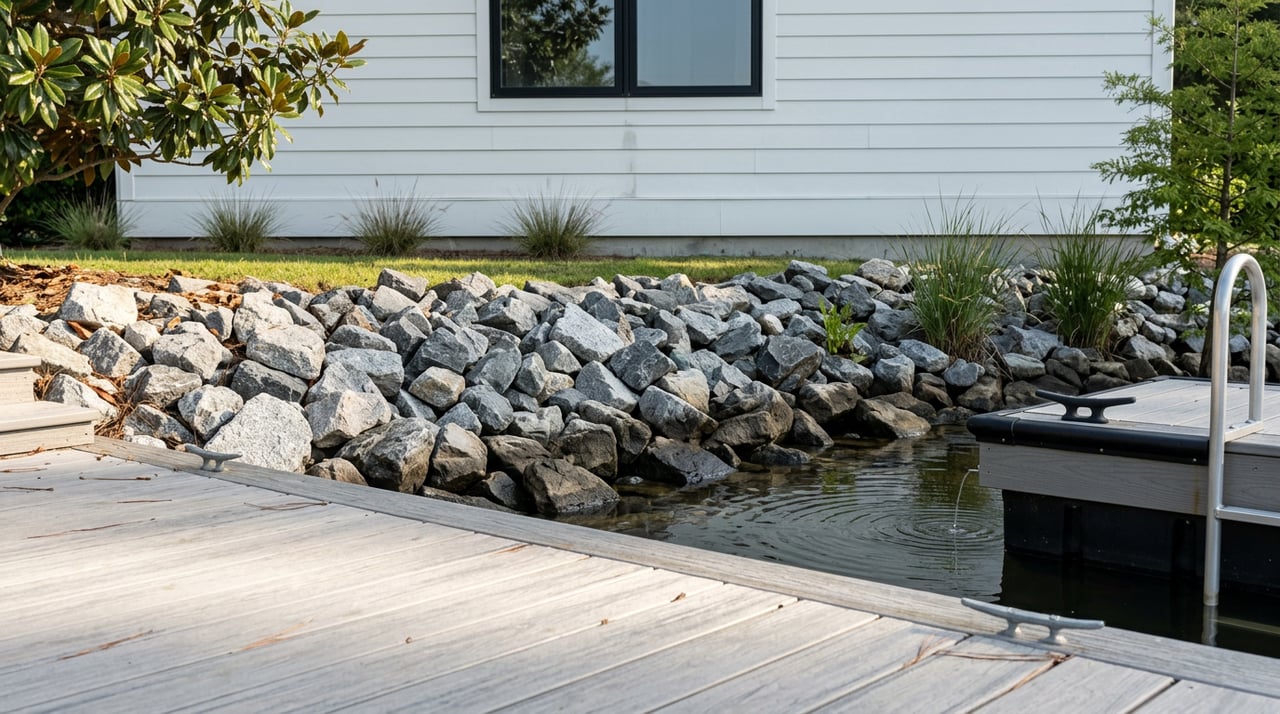
Buyers touring Lake Gaston homes this summer keep asking the same question in a slightly different way. They point at the double boathouse, the covered slip, the fresh riprap, and they ask what it would cost to replace. It is the wrong question. The right question is whether any of it is legally the seller's to convey.
On Lake Gaston it usually is not. The house is yours to buy. The shoreline, the water, and the structure sitting on both belong to Dominion Energy, and what changes hands at closing is a permit, not a deed.
Dominion built the impoundment in 1963 and operates it under a Federal Energy Regulatory Commission license. The project boundary graduates from 204 feet above mean sea level at Lake Gaston Dam to 217 feet at Kerr Dam. Everything below that line, including the ground your boathouse posts stand on, is Dominion property.
That distinction has been true since 1998. What changed in 2025 is how much it costs a seller to gloss over it.
Why permit files became a pricing lever this year
The 2025 recap from the Roanoke Valley Lake Gaston Board of REALTORS tells a coherent story if you read past the median. Waterfront homes closed at an average of $959,087 across 186 transactions, with a median of $832,500. Dollar volume was up 12.44 percent over 2024. That is the headline number, and it is misleading.
The two numbers underneath it are the ones that matter for anyone under contract right now. In 2025 waterfront homes sold at 96.15 percent of asking, down from 98.24 percent in 2024. And days on market for waterfront homes rose 44 percent year over year. Buyers took longer to commit and paid closer to their own number when they did.
In a market where the average waterfront sale is trading nearly four points below list, every discoverable defect gets priced. An unpermitted dock extension, a bulkhead repaired past the 50 percent threshold, a boathouse that quietly grew a 200 square foot storage room during a 2019 renovation — these are no longer paperwork problems. They are the exact items a buyer's agent points to when justifying a $40,000 concession on an $850,000 cove home.
The 50 percent rule is where quiet deals go loud
Dominion's Construction and Use Procedures, last revised in May 2022, allow an owner to maintain an existing pier, boathouse, bulkhead, or riprap section without a new permit as long as 50 percent or less of the structure needs repair. Cross that line and the structure must come down. Rebuilding is allowed only under a fresh permit and under current regulations, which are more restrictive than the rules many older docks were built to.
The trap for sellers is that the 50 percent measurement is not something the owner gets to declare. Dominion inspects. And a boathouse that has been patched three times over fifteen years, one stringer here and a couple of decking boards there, can quietly reach a cumulative point where the reservoir program manager, currently Josh Simpson at 252-410-6306, will not sign off on continued maintenance.
The friction for buyers is the mirror image. A grandfathered structure keeps its grandfather status only "for its useful life" and only if it remains in compliance with the size and construction specs from the permit that built it. Buy the house, discover during your first storm that half the boathouse roof needs replacement, and you may be looking at removal and a new-standards rebuild — inside a 1,250 square foot footprint cap, with the A-roof or sundeck limited to 16 feet above the 200-foot water surface, and at least 15 feet inside both extension lines.
What "grandfathered" does and does not mean
The word gets used loosely around the lake. It has a narrow technical meaning under the SMP.
A grandfathered structure is one built under a valid Dominion license agreement and still in compliance with the specs in force when it was built. A previously approved permit for a structure that was never actually built, completed, and inspected is not grandfathered. That matters because sellers sometimes market a lot as "dock-approved" based on old paperwork. If the boathouse was never constructed and closed out, the approval expired at the 12-month mark and any new owner is applying under current rules, on current shoreline classifications.
Those classifications are the second sleeper issue. Dominion maps every foot of the 350-plus miles of shoreline into General Development Areas — parcels platted before May 31, 1998, or since deemed low environmental impact — and Special Management Areas, which are further split into Limited Use, Sensitive, and Undevelopable. A lot in a Sensitive area may not qualify for the same size or configuration of dock as the neighbor's lot 400 feet away. The Lake Gaston Association publishes a plain-language walkthrough of the classifications, and Dominion's construction and use PDF holds the underlying maps.
The five documents to have in hand before you release diligence
Do not take the seller's word for any of this. Ask for the file. If it is not intact, the diligence period is when you find out, not the week after closing.
| Item | What you are looking for | Where it lives |
|---|---|---|
| Current Construction and Use permit | Issued in the seller's name, matches the structure actually on the property | Dominion Energy shoreline office, 100 Oakwood Ave, Roanoke Rapids |
| Approved drawings and dimensions | Match footprint, extension-line setbacks, and enclosed storage on the ground today | Attached to original permit |
| Property survey | Confirms the extension lines and the 204 to 217 foot project boundary | Seller's closing file, or new survey |
| Replanting plan close-out | Documents the six feet of the twelve-foot construction path that had to be revegetated | Dominion file |
| Riprap or bulkhead permit history | Any shoreline stabilization needs its own approval; new bulkheads are no longer allowed | Dominion file |
A seller who can produce all five within a week of request is offering a clean transaction. A seller who cannot is offering a negotiation.
What sellers should reconcile before the sign goes up
The same list runs in reverse. Sellers who spend a Saturday walking the shoreline with a copy of the original permit almost always find at least one small drift between what is approved and what is standing. A rebuilt lift that added weight beyond the original spec. A storage area that quietly grew past 100 square feet, or that migrated more than 10 feet from the landside back of the structure. A sand delivery for a swim area, which is prohibited because imported sand cannot be introduced on Dominion property. An irrigation pump on the boathouse that was never permitted.
Cleaning these up before listing is inexpensive. Cleaning them up during a buyer's diligence period, with a closing date already circled on a calendar, is where sellers lose real money. In a 96.15 percent list-to-sale market, the buyer's concession request will almost always exceed the actual cost of compliance.
For high-value waterfront listings, the calculus is starker. Sixty Lake Gaston waterfront homes closed at or above one million dollars in 2025, the highest at $3.4 million. In that segment the buyer is typically working with a real estate attorney who will read the SMP. Assume the file will be examined and prepare accordingly.
Frequently asked questions
Does the permit transfer automatically when I buy the house? No. Dominion requires a Construction and Use Agreement Transfer, and the office at 100 Oakwood Ave processes it. The permit is tied to the adjoining property owner, so the transfer needs to happen as part of the closing workflow, not months later.
Can I add a dock to a lot that does not have one? Maybe. It depends on the shoreline classification, the width of the buildable frontage between extension lines, the 15-foot setback from neighboring structures, and whether the lot sits in a Sensitive or Undevelopable area. A survey and a pre-application conversation with Dominion is the honest first step, and the current application fee runs $600.
What about the aquatic plants along my shoreline? Willow weed, cattails, arrowhead, and similar aquatic vegetation are protected under Dominion's FERC license and cannot be removed or chemically treated. Buyers who dislike marshy edges should walk the shoreline in season before writing an offer.
Does any of this apply to riprap? Yes. Riprap installation requires its own permit, and Dominion now requires riprap waterward of any new bulkhead. Existing bulkheads can be maintained but not newly installed.
Lake Gaston rewards owners who understand what they actually own and what they are permitted to use. That understanding is also what separates a smooth closing from a renegotiation. If you are getting ready to list a waterfront home this season, or you are under contract and want a second read on the shoreline file, the team at The Watson Group has spent years on the dock side of these transactions. Reach out for your free Lake Gaston home valuation, and we will walk the shoreline with you before the listing photos are ever scheduled.