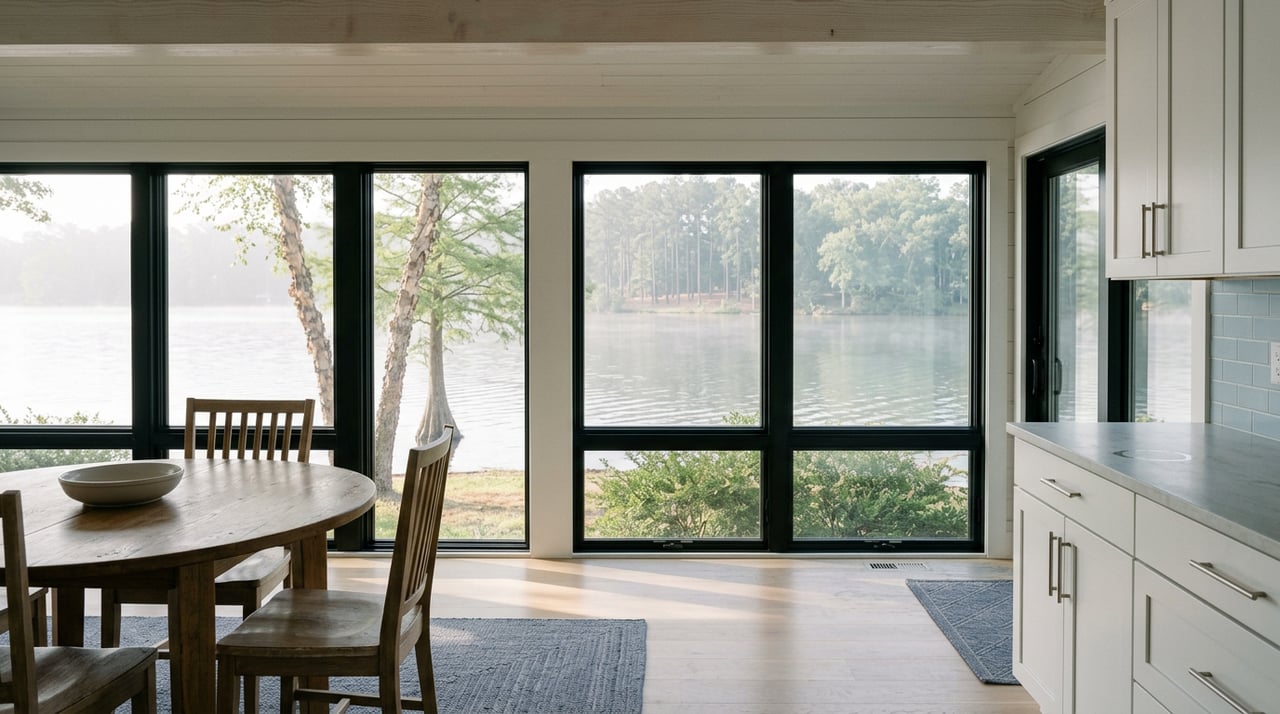
If your cove looked weedier this July than it did last summer, you were not imagining it. And if you have noticed a boat or kayak moving slow and deliberate along the shoreline in the last two weeks, tossing a rake overboard every couple hundred feet, that is not a fishing technique. The Lake Gaston Association's volunteer shoreline survey typically opens in mid-August and runs through the end of October, and it has landed on nearly that same window every year for at least the last several seasons. Right now, on this lake, that survey is underway.
What most residents never learn is how much power that clipboard-and-rake exercise actually holds. Whether your cove gets professionally treated for invasive weeds next year, and whether the county-funded program even knows your water exists, comes down almost entirely to what gets logged during those ten weeks. The acreage numbers that get reported in the local paper each spring look like a verdict on the lake's health. They are really a verdict on where people looked.
Two plants, two very different playbooks
Lake Gaston has two vegetation problems, and they are not the same problem wearing different names. Hydrilla is a submerged plant, first documented in the lake in the 1980s, that spreads through fragments and underground tubers that can sit dormant in the lake floor for years before sprouting. Lyngbya is technically a cyanobacterium, not a plant at all, and it has been present since the mid-1990s. It forms black mats that sit below the surface in winter and spring and rise to the top in summer and fall, and it carries an odor most lake residents learn to recognize before they ever learn its name.
The two require different chemistry. Hydrilla treatments use EPA-approved herbicides broadcast as granular pellets from boat-mounted units, and they carry water-use restrictions on irrigation for a period after application. Lyngbya gets chelated copper-based algaecides instead, which have no such irrigation restriction but need four to six consecutive monthly treatments spread across multiple years before a colonized area actually clears.
For 2026, the Lake Gaston Weed Control Council approved treating no more than 500 acres for lyngbya and 408 acres for hydrilla, based on recommendations from the Pete Deschenes Stakeholders Board's technical advisory group. The season's hydrilla-specific rollout began the week of May 18 and ran three consecutive monthly rounds, May 19-21, June 16-18, and July 14-16, covering 326 acres. PLM Lake & Land Management Group handled the hydrilla applications by boat, and the council also contracts with Aqua Services for lyngbya treatments. Dominion Energy is funding roughly 1,300 sterile triploid grass carp to be stocked in the lake this year as a biological backstop, since the carp graze on hydrilla and reduce how much acreage the herbicide program has to cover in the first place.
The number that looks worse than it is
Here is where most coverage of this topic gets the story backwards. The 2025 survey, run by nearly 200 volunteers between mid-August and the end of October, estimated hydrilla acreage on the lake had grown to 468 acres, up enough that the council doubled its treatment acreage for 2026 compared to the year before. Read on its own, that sounds like the lake is losing ground against an invasive plant it has fought for four decades.
Set against the actual baseline, the story flips. At its peak in 2005, hydrilla covered an estimated 3,800 acres of Lake Gaston. The 468 acres logged in 2025, even after an increase, represents roughly an eighth of that peak. The plant has not staged a comeback. It has stayed roughly where it has been for years, and one specific change in survey methodology accounts for a meaningful chunk of the apparent jump.
"This is the first time we've seen under 1,000 acres since 2019."
The Lake Gaston Gazette-Observer quoted NCSU Extension Associate Jessica Baumann while reporting on her presentation to the Weed Control Council in early 2026. The report also contrasted that decline with hydrilla’s apparent increase. Baumann also noted that a portion of the hydrilla increase, 120 of the 468 acres, traced directly to a new survey team using kayaks to reach shallow water that motorized boats had always missed. The plant did not necessarily spread. The survey got better at finding it.
Why upper creek arms carry more of it
If your dock sits well up a creek arm rather than near the main channel, you are simply more likely to deal with vegetation, and that is not bad luck. The upper reaches of most creeks feeding Lake Gaston are shallower, warmer, and slower moving than the open lake, which is exactly the combination both hydrilla and lyngbya prefer. Survey and exclosure work over the years has concentrated in exactly those zones, places like Poplar Creek, Great Creek, and Hawtree Creek, because that is structurally where the plant establishes first and holds on longest. A dock near Eaton Ferry Bridge on the open main channel is working with a different baseline than a dock two miles up a tributary, and that difference shows up in the survey data every single year.
Getting your cove into next year's plan
The mechanism that actually decides who gets treated deserves more attention than it usually gets. When a volunteer or a homeowner reports vegetation through the Lake Gaston Association's public reporting form, one of two things happens. If the plant identified is a native species, the council has no authority to direct funded treatment toward it at all. Per Dominion Energy's own shoreline management rules, whether a native plant even counts as a navigational nuisance is left to a licensed applicator's judgment, and if you want it gone, you are hiring and paying for that work yourself.
If the report identifies hydrilla or lyngbya, your property gets added to a running database the council maintains year over year. That is not a guarantee of funded treatment. Available money is the actual constraint, not available acreage, and the council has been explicit that entries in the database simply keep a property in the conversation for future planning.
Here is the part that catches people off guard nearly every summer. By the time treatment problems become visible in June or July, that year's plan has already been locked. The Lake Gaston Association confirmed in a mid-2026 update that all treatment programs for the year had been finalized and additional areas could not be added. Anyone whose cove was not already flagged before the council's spring decision meeting is looking at two options for the rest of this season: hire a private licensed applicator now, or make sure the property is in the database before next year's technical advisory group makes its recommendations, which has historically happened in late winter.
A few things worth doing before that window closes again:
- If you have seen thick underwater growth or the telltale black mats of lyngbya, file a report through the LGA's public form even if it is too late to help you this season. It puts you in line for next year's TAG recommendations.
- If a private applicator tells you what is growing near your dock is a native species, understand that funded treatment is not coming regardless of how it looks. Native vegetation supports the fish habitat that makes this lake worth living on in the first place.
- Ask around your section of shoreline before assuming your cove was surveyed at all. With roughly 350 miles of shoreline split across 100-plus sections and covered by volunteer teams, coverage varies year to year based on who signs up and where.
Understanding how a cove earns its way onto the treatment map, or gets left off it, is the kind of thing that only matters once you actually live on the water. It is also the kind of detail that shapes how a property shows when the day comes that you are thinking about what is next for it. The Watson Group tracks these details on Lake Gaston the way we track dock permits and shoreline rules, because the water in front of a property is as much a part of it as the house behind it.
Get your free Lake Gaston home valuation and let's talk about what your stretch of shoreline is actually worth this year.
This article is general information, not legal, tax or financial advice. Consult a qualified professional about your situation.