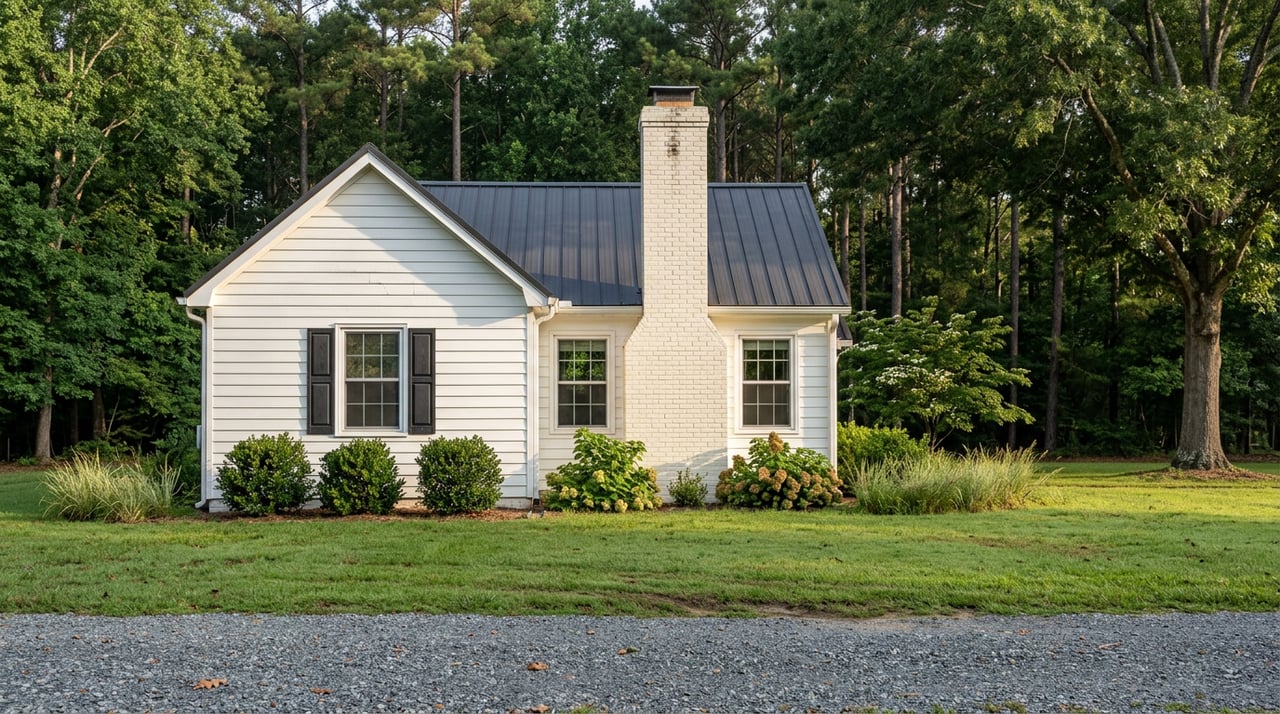
Most buyers shopping for acreage near Norlina compare price per acre. Road frontage, tree cover, how far the drive is from Ridgeway or the Lake Gaston shoreline. Those are the numbers that show up in the listing and the numbers people argue about at the kitchen table before they write an offer.
The number that actually decides what the land is worth rarely makes it into the conversation until it is too late to walk away cheaply: the soil group classification tied to the property's septic Improvement Permit. Two lots with identical acreage, identical road frontage, and nearly identical asking prices can carry a cost gap of tens of thousands of dollars once you know what the ground underneath will and won't support. That gap is the real story for anyone buying rural or acreage property in Warren County, and it has nothing to do with how the land looks from the road.
The document that outweighs the price tag
In North Carolina, before a septic system goes in, the county environmental health department (or a private evaluator) has to classify the soil. That classification, documented in what the state calls an Improvement Permit, sorts land into Soil Groups I through IV and specifies exactly what type of system the site can support. A property with Group I or II soil can typically run a conventional system for somewhere between $3,000 and $7,500. A property that comes back Group IV needs an advanced or engineered system, and that number climbs to $20,000, sometimes $70,000 or more, for the system alone.
That is not a rounding error on a land purchase. It is often a meaningful percentage of the sale price itself, and it is invisible until someone actually pulls a soil sample.
Warren County's terrain makes this worth taking seriously rather than treating as boilerplate. Septic contractors working the Warrenton and Norlina area describe the ground here as clay-heavy Piedmont soil over rolling terrain, conditions that call for careful drain field engineering rather than a rubber-stamp approval. That description does not mean land near Norlina is bad for building. It means the soil test is not a formality you can skip because the lot looks solid.
An Improvement Permit, once issued, is valid for five years. If a property already has one on file, that is a genuine advantage, but the issue date matters. A permit from early in that window still has time on the clock. One nearing the five-year mark may need a fresh look, especially if grading, nearby construction, or drainage on adjoining land has changed since the original evaluation.
Getting that evaluation done through the county comes with an application fee generally in the $200 to $400 range and includes the soil work. Buyers on a tighter contract timeline sometimes hire a private Authorized On-Site Wastewater Evaluator instead, which runs $300 to $800 but can often get someone on site within one to two weeks rather than waiting on the county's schedule. Either path ends with the same document. The point is not to skip the step. It is to build it into the contract as a contingency rather than discovering the answer after closing.
| Soil Group | System type | Approximate cost |
|---|---|---|
| Group I-II | Conventional | $3,000 to $7,500 |
| Group III | Modified or low-pressure pipe | Varies by site |
| Group IV | Advanced or engineered | $20,000 to $70,000+ |
For homes that already have a system, the bedroom count is the real ceiling
Buying vacant land is one scenario. Buying an existing home on septic near Norlina raises a different, quieter version of the same issue.
North Carolina septic permits are not rated by bathroom count. They are rated by bedroom count, on a rough formula of two people per bedroom, because that number better predicts actual daily water use than fixture count does. A three-bedroom home's system is sized for roughly 330 gallons a day. That means the number of bedrooms a home can legally be marketed with has to match what the permit on file actually authorizes, not what a floor plan happens to show.
This is where things get messy for older rural housing stock, and Norlina's homes skew older and smaller than the county average. If a previous owner converted a den or an office into a fourth bedroom without updating the septic permit, the system was never sized for that use. North Carolina real estate agents are required to check the county's permit record and represent the property based on what the permit actually supports, not what the layout suggests. When no record can be found at all, current guidance from the state is straightforward: disclose that plainly rather than guess. A home can still be marketed accurately even when the original permit has gone missing, as long as everyone involved says so in writing instead of assuming the best case.
For a buyer, this means one question belongs on every septic-served property near Norlina before an offer goes in: can the seller produce the permit, and does the bedroom count on that permit match the bedroom count in the listing? If the answer is no on either count, that is a conversation to have before closing, not a surprise to inherit after.
The lot with the prettiest view and the lot with the cheapest septic system are rarely the same lot. Near Norlina, the soil report decides which one you actually bought.
Norlina runs its own zoning, separate from the county
Here is the detail that catches even careful buyers off guard: Norlina is not just a place inside Warren County. It is a town with its own zoning authority, and that authority extends beyond the town limits themselves.
Warren County's planning department is explicit on this point: Warrenton and Norlina each hold separate zoning jurisdiction over their corporate limits and a one-mile extraterritorial boundary around them. Inside that boundary, the town, not the county, decides what a zoning permit requires, and the town's own office, located at 139 Hyco Street, handles zoning maps and questions directly.
Why this matters in practice: a five-acre parcel that looks like classic rural Warren County land on a map might actually sit inside Norlina's one-mile extraterritorial jurisdiction, which means Norlina's zoning rules, not the county's, govern what can be built, subdivided, or converted there. A buyer who assumes county rules apply because the address feels rural can end up surprised at the permit counter. Before making an offer on acreage near town, it is worth a direct call to confirm whether the parcel falls inside that boundary and, if so, which office actually issues the permit you will need.
Private wells add a second layer worth planning for
Most acreage near Norlina runs on a private well rather than a municipal water line, and that carries its own maintenance rhythm separate from the septic question. State guidance recommends testing for total and fecal coliform bacteria every year, testing for heavy metals, nitrates, and lead every two to three years, and testing for pesticides and volatile organic compounds every five years. Wells across North Carolina can carry naturally occurring lead, arsenic, iron, or manganese depending on local geology, and none of those are things you can taste, see, or smell your way into detecting. A lab test is the only way to know.
For a buyer, this is a due diligence item, not a red flag by default. Ask for the most recent water test results along with the septic paperwork. If the well was installed after July 2008, state rules required it to be tested within 30 days of construction, so a record should exist somewhere.
What to request before you write an offer
- A copy of the current Improvement Permit, including the issue date and soil group classification
- The septic permit's authorized bedroom count, compared against the actual layout
- Confirmation of whether the parcel sits inside Norlina's town zoning jurisdiction or under county authority
- The most recent private well water test, if the property is not on municipal water
- Warren County's Permits and Inspections office can confirm septic and zoning records directly for a specific parcel
Frequently asked questions
Does North Carolina require a septic inspection before closing? Not by state statute for every transaction. In practice, most mortgage lenders, particularly for FHA and VA loans, require one as a loan condition, so budget for it and schedule it early rather than treating it as optional.
What happens if the septic permit for an older home can't be found? Current state guidance is to disclose exactly that: the bedroom count as it exists, along with the fact that no permit record could be located. That transparency limits liability for everyone involved far more than guessing would.
Is land inside Norlina's town limits regulated differently than land in the surrounding county? Yes. Norlina holds its own zoning authority over its corporate limits and a one-mile extraterritorial boundary. Outside that boundary, Warren County's zoning applies instead, and the two offices issue different permits.
How often should a private well actually get tested once you own the home? Annually for bacteria, every two to three years for heavy metals and nitrates, and every five years for pesticides and volatile organic compounds, per state environmental health guidance.
Land near Norlina rewards buyers who ask about the ground before they ask about the view. If you are weighing acreage, a rural resale, or a lakefront property anywhere across the Lake Gaston region, The Watson Group can walk the permit history and zoning jurisdiction with you before you're locked into a contract. Get your free Lake Gaston home valuation and let's talk through what a specific parcel actually allows.